
Azouki… Historical Treasures Overlooked by the National Museum
Adrar Region, Mauritania –
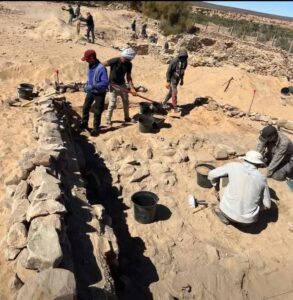
Just a few hours northeast of the city of Atar, in the vast Mauritanian desert, the archaeological site of Azouki unveils rich historical secrets dating back to the medieval era, reflecting the region’s role as an important commercial and cultural hub in West African history.
French researchers, during recent excavations resumed in 2025 under the MAAT program after a long hiatus, uncovered a dry-stone castle featuring walls and precise compartments that demonstrate the development of settlement and urban expansion over centuries. The excavations also revealed traces of trans-Saharan trade, including pottery imported from Morocco and glass originating from Andalusia and the Middle East, confirming Azouki’s position as a hub of trade between North Africa and the Sahara.
What is particularly striking is the discovery of Almoravid dinars, the first known coins in the region, symbolizing Azouki’s economic wealth and its role within the Almoravid Empire. Additionally, locally produced pottery of high technical and aesthetic quality was found, which may have been distributed regionally, along with graves of prominent religious figures such as Imam Al-Hadrami Al-Muradi, an important Islamic jurist and judge of the Almoravid state, which originated in the Mauritanian desert and extended its rule over the Maghreb, West Africa, as well as parts of Spain, Portugal, and southern France—a testament to the far-reaching influence of the Almoravid state in the region.
● But the question remains: why are these artifacts not displayed in the National Museum?
Despite the significance of these discoveries, many items—including Almoravid dinars, some pottery, and imported glass—have yet to be exhibited in the Mauritanian National Museum. Mauritanian and French archaeology experts point to several reasons for this:
Lack of restoration and preservation: Some items require complex restoration processes before they can be safely displayed.
Limited museum capacity: The National Museum faces challenges in accommodating large and diverse artifacts.
Scientific documentation priorities: Researchers sometimes prefer to study and analyze items fully before public display, ensuring an accurate understanding of their history and significance.
Security considerations: Protection of artifacts from theft or damage during transport or exhibition.
● Azouki… An Almoravid Capital and a Candidate for World Heritage Status
Historical studies, including those by the 11th-century historian Al-Bakri, indicate that Azouki was the first capital of the Almoravid Empire in the region, granting it considerable political and cultural value. The site has been included on UNESCO’s tentative list for World Heritage since 2001, reflecting its regional and global importance.
The new archaeological program aims to enhance the protection of the site and make more discoveries accessible to local and international audiences, while researchers hope that future plans will allow a broader display of artifacts at the National Museum, including Almoravid dinars and both imported and local pottery, turning Azouki into a window on Mauritania’s relatively unknown history.
● In conclusion, Azouki is not merely a stone ruin in the Mauritanian desert; it is a living witness to the economic, cultural, and religious history of the Almoravid Empire. Experts hope that its discoveries will soon become part of a permanent exhibition showcasing Mauritania’s rich heritage to the world.