
Ndar, a Gateway to Deep Dialogue Between Mauritanians and Senegalese
By Mohamed Abderrahmane Abdallah, Mauritanian journalist and writer
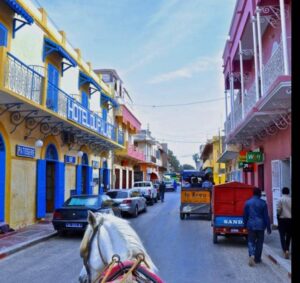
Ndar — Saint-Louis — is not just a city perched on the banks of the Senegal River.
Where the water flows between the desert and the savanna, it stands as a living memory of the human, cultural, and spiritual relationship between Mauritania and Senegal. A relationship neither politics nor maps created, but one woven by people through knowledge, love, kinship, trade, and Sufism.
For centuries, Ndar was the meeting point for those coming from the north of the river: scholars from Chinguetti and Ouadane, jurists from Tichitt, spiritual masters, desert emirs, traders, and travelers. All found in this coastal city a space to settle, work, and exert influence.
Ndar was not just a colonial trading post, but a true crucible of civilizations, where the Saharan spirit met the African soul to create a refined hybrid culture, blending asceticism and commerce, mahadra and market, jurisprudence and poetry.
“Kanar”: an identity that crossed the river
In Wolof memory, Mauritania was known as “Kanar,” the North, the Saharan bush. Arabs were called “Nar,” and Mauritanian Arabs “Nar Kanar.”
This was not a mere linguistic designation, but a recognition of social and cultural status: the Kanari was the scholar, the honest trader, the Sufi sheikh, the respected judge. The Mauritanian in Ndar was not a foreigner, but one of the city’s pillars.
From the market to the family
Through Ndar passed Mauritanian caravans loaded with gum arabic, livestock, and leather, returning with tea, sugar, fabrics, and books. But more than goods, it was people who circulated.
Here, exchange went beyond economics to become alliances and kinship. Mauritanians and Wolofs, Sérères, and Toucouleurs intermarried, giving birth to generations with dual heritage, who perceive themselves as children of the same space.
Today, it is estimated that nearly three million Senegalese are of Mauritanian origin, mostly integrated into the Wolof world. They do not form a foreign community, but a human continuity of a long history of coexistence.
Ndar, a gateway to knowledge and Sufism
Ndar was also a spiritual capital.
From its mosques radiated Maliki jurisprudence, from its zaouïas spread the great Sufi brotherhoods, and its scholars contributed profoundly to the formation of Senegalese Islam. Through Ndar, the Tijaniyya and Qadiriyya penetrated the heart of Senegal, connecting Nouakchott to Tivaouane, Kaolack, and Dakar within a single network of knowledge and spirituality. The river was a bridge, not a border.
A memory stronger than borders
Even when politics drew lines between Mauritania and Senegal, Ndar remained a witness to a time without borders, where the desert and the river formed a single world, and identities intertwined without fear.
Recalling Ndar’s history is not a cultural luxury, but an act of resistance against forgetting, and a rehabilitation of one of West Africa’s most beautiful human experiences.
Ndar is neither solely Senegalese nor solely Mauritanian.
It is a shared homeland, born before borders and living beyond maps.