
N’Diago Port: Development Partnership or Sovereign Concession?
By: Mohamed Abdarahman Ould Abdallah – Journalist & Writer
Nouakchott, Mauritania
Whenever the government announces a new “partnership” between the state and the private sector, the same question inevitably resurfaces: are we witnessing rational economic reform, or another chapter in the gradual surrender of sovereign national assets?
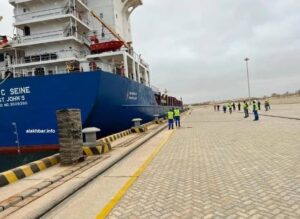
Today, the debate has returned with renewed intensity following discussions about transforming the N’Diago Port into a Public-Private Partnership (PPP) project — a venture expected to become one of the pillars of Mauritania’s maritime sovereignty and national economy.
But the issue goes far beyond a single port. It concerns the very philosophy of economic governance.
A Port Is Not Just Infrastructure — It Is a Sovereign Decision
In a coastal country like Mauritania, a seaport is not merely infrastructure for unloading containers.
It is a gateway to fisheries wealth, an export outlet, and a geopolitical leverage tool within the Sahel and West African region.
Whoever controls a port influences the flow of goods, customs revenues, employment opportunities, and even regional power balances.
Can such a strategic asset truly be managed under a purely profit-driven logic?
Why Does the State Turn to Partnerships?
The government presents arguments that appear reasonable:
Limited public financing capacity
High infrastructure costs
Need for operational expertise
Risk sharing
In theory, Public-Private Partnerships are modern and effective instruments that have succeeded in many countries. However, their success depends on transparency, contractual balance, and strict oversight.
And this is precisely where concerns begin.
The Mauritanian Experience: Partnership or Disguised Privatization?
Previous experiences in managing national resources — from fisheries to mining — reveal troubling patterns:
Contracts rarely disclosed to the public
Broad tax exemptions
Profit transfers abroad
Weak parliamentary oversight
The state ultimately bearing the cost of failure
In many cases, risks are socialized while profits are privatized.
So where is the “partnership” when the balance of power is unequal from the very start of negotiations?
Structural Causes Behind the Imbalance
Several underlying factors cannot be ignored:
1. Fragile Negotiating Position
A small economy, urgent financing needs, and political pressure for quick results often push the state into negotiations from a position of weakness.
2. Absence of Long-Term Strategic Vision
Projects are frequently treated as short-term solutions to funding shortages rather than components of a sovereign decades-long national strategy.
3. Profit Logic Over Public Interest
Private investors naturally seek profit maximization, while the state’s role is to safeguard national interest. When regulatory capacity weakens, the balance inevitably shifts toward investors.
N’Diago Port: Between Necessity and National Prestige
No one denies that the port project has faced years of delays.
Nor is there disagreement about the urgent need for maritime infrastructure in southern Mauritania to stimulate local development and create employment.
But the fundamental question is not:
Do we need a partner?
Rather:
Under what conditions — and for whose benefit?
If partnership means:
Publishing contracts for public scrutiny
Clearly defining concession duration
Guaranteeing a fair share of profits for the state
Requiring employment of national labor
Subjecting the project to independent financial oversight
Ensuring the asset returns to the state in proper condition after concession expiry
then it is a genuine development partnership.
But if it means:
Long-term concessions without transparency
Open-ended tax exemptions
Near-total operational control by investors
Absence of effective oversight
then this is not partnership — it is deferred privatization.
The Questions That Must Be Asked Publicly
Why are agreement details not disclosed?
Why is there no broad parliamentary or public debate?
Why do strategic national projects remain closed files until the moment of signing?
A strong state does not fear transparency.
A true partnership does not fear scrutiny.
The Issue Is Not Opposition to the Private Sector
The private sector is an essential partner in any modern economy.
But partnership does not mean relinquishment, and modernization does not require abandoning instruments of sovereignty.
N’Diago Port: A Real Test
Either it becomes a model of a balanced contract that protects national interests while attracting investment,
or it turns into another link in a chain of “necessary concessions” justified by urgency but paid for by future generations.
Ultimately, the issue is not merely a port.
The real question is:
Do we have a state that negotiates from a position of sovereignty — or one that trades time for liquidity?
The difference between the two is the difference between development… and dependency.