
A New Life… A Neighborhood Without Life!
A journalistic feature story
By : Mohamed Abdelrahman
Ould Abdallah
Journalist and Writer,
medabd388@gmail.com Nouakchott
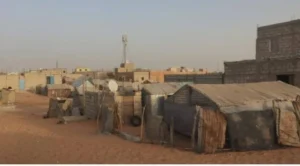
In the early morning, as the sun begins to stretch across the sands of Nouakchott, the district of Hayat Jadida (“New Life”) wakes up to the same scene that has remained unchanged for years: houses made of zinc and corrugated metal, narrow alleys crossing chaotically, and faces worn down by poverty until it has become part of their very features.
Although the neighborhood’s name suggests hope and a fresh beginning, the reality tells the story of an old life of misery, repeated every day as if time stopped on the very first day people settled here.
Mariam: A School That Has Become a Distant Dream
At the edge of the neighborhood sits Mariam, an 11-year-old girl, staring silently at the dusty road leading to a school more than a kilometer away.
In a faint voice, she says:
“I used to study… but I can no longer go to school. It’s too far from where we live, and the road is dangerous and deserted.”
Mariam lives with her mother and four siblings in a single room.
Her mother works as a house cleaner, with no job security and no stable income.
She says:
“Education is important… but we are still struggling every single day just to find food.”
Here, the right to education turns into a luxury in a neighborhood that was designed to be temporary housing but became a permanent burden on the chests of its residents.
A Well Without Water… And Water Without Cleanliness
A few meters away stands Sheikh Ba — “the man with twenty years of exhaustion,” as he jokingly calls himself — beside a cracked earthen well.
Wiping sweat from his forehead, he says:
“We used to have a public water tap, but it broke down a year ago. The municipality never came. So we use this well. The water isn’t safe, but it’s all we have.”
Contaminated water causes intestinal and skin diseases, yet there is no alternative.
The neighborhood lies outside the water network coverage — and practically outside the map of the responsible authorities altogether. Occasionally, charitable organizations provide limited quantities of drinking water, but it is neither enough for everyone nor sustainable.
Darkness That Swallows the Nights
As evening falls, Hayat Jadida sinks into complete darkness.
There are no streetlights and no reliable electricity. Homes rely on worn-out electrical wires stretched across the sand, illegally connected to unknown power sources, often causing sudden fires.
Ismail, one of the residents, says:
“Every week we hear about another house burning because of these random electrical connections. It feels like we live in another world — inside the capital itself.”
Families on the Edge of Hunger
In another home, Fatima sits with her three children around a small pot of rice.
Trying to divide the little food among them, she explains:
“We don’t know how we will survive the summer and the days of thirst. Transportation to the center of the capital costs too much every day and every month. There are no job opportunities here either. Prices are rising, and most men are unemployed.”
Poverty here is not a temporary condition; it is a way of life imposed by harsh circumstances.
Families have no stable work, no government support, and no ability to cope with food prices that rise almost every week.
A Neighborhood Without Documents, Services, or a Voice
Most residents of Hayat Jadida originally came from informal settlements and were themselves displaced from the countryside — in what seems like a journey from poverty back into poverty — due to droughts, floods, or failed hopes of finding work opportunities.
Many possess no land ownership documents, and some do not even have complete civil registration papers, making them effectively invisible to the state.
Some are absent from official databases altogether.
Absent from aid programs.
This neighborhood remains one of the poorest areas in Nouakchott, although it may soon lose that title due to the growing number of competing districts sinking into similar misery and deprivation.
One elderly resident says:
“We are not asking for palaces… We ask for drinking water, roads, electricity, and schools for our children. And we ask for security, because we live in a semi-isolated area.”
A Question Hanging in the Air
The neighborhood stretches across the outskirts of Nouakchott, caught between desert and city, yet belonging to neither.
It feels like a place disconnected from time itself — waiting for relocation for twenty years, and waiting for development for forty.
Despite politicians’ promises during every election season, Hayat Jadida remains outside the circle of attention. It benefits neither from housing programs, nor water networks, nor poverty-support initiatives.
And so the question repeatedly echoes among its residents:
“Do we need a new name… or a truly new life?”
This example of poverty and deprivation is replicated across many Mauritanian cities. It is the natural result of decades of corruption, mismanagement, looting of public resources, and policies that have deepened hunger and social marginalization under successive corrupt regimes.